14 · Reading the five figures
What you will have done: read each of the five figures on Reports, known what population each one counts, and opened the rows behind one you disagreed with.
Why five figures and not a dashboard
A dashboard is a wall of numbers nobody can argue with. Each of these five states itself in a sentence, and every one of them opens onto the rows it was counted from, in the same screen. The point is that you disagree with one and go and look.
Revenue › Reports.
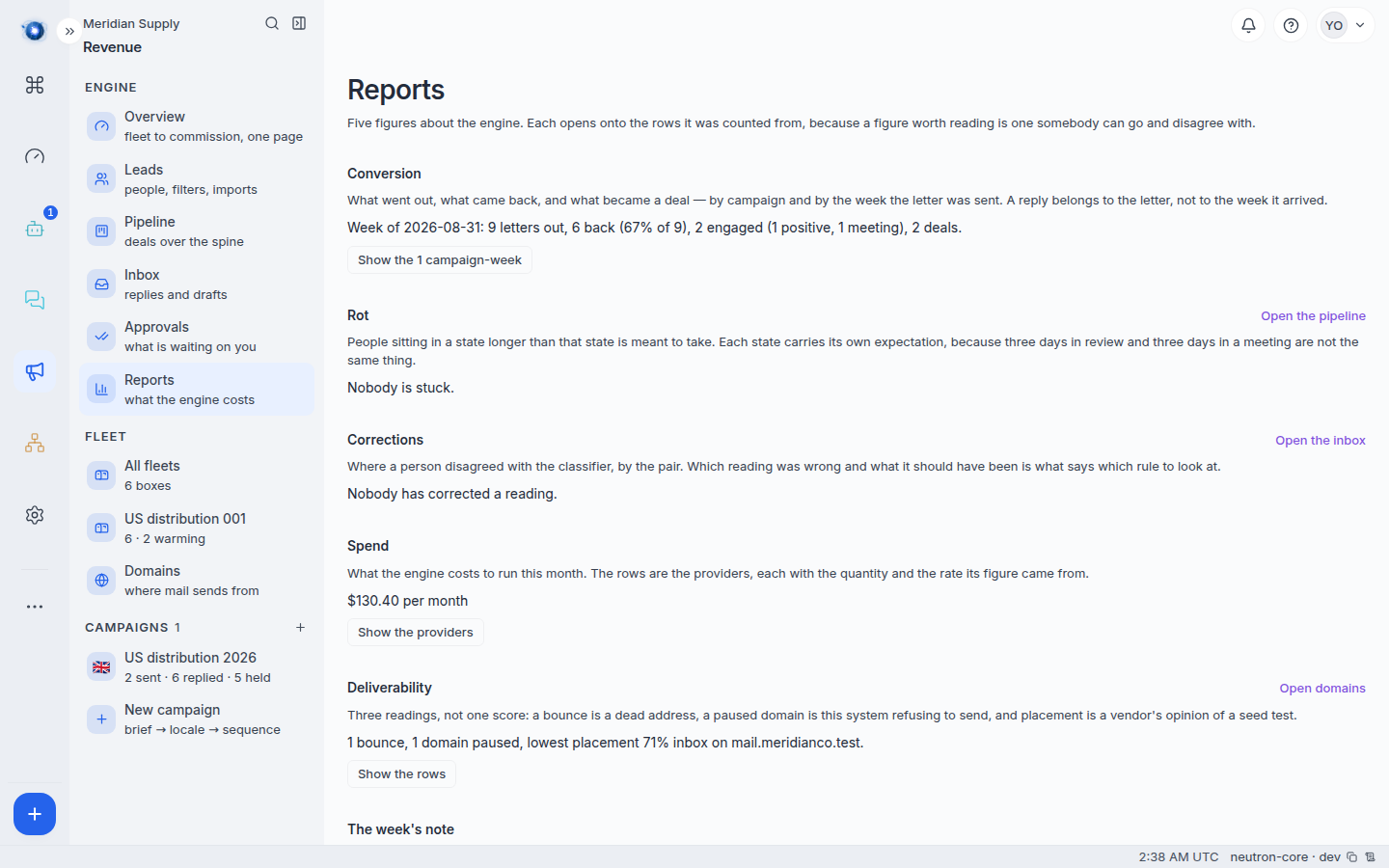
1. Conversion
What it answers: of the letters that went out, how many came back, how many of those engaged, and how many became a deal.
Week of 2026-08-31: 9 letters out, 6 back (67% of 9), 2 engaged (1 positive, 1 meeting), 2 deals.
Three things about that sentence are deliberate.
The week is the letter’s, not the reply’s. A reply to last week’s letter belongs to last week. Moving it into the week it arrived would show a week converting better than it sent.
Letters are the denominator and people are the numerator. Writing to somebody twice is two letters; their one answer is one reply however many letters it followed.
“Engaged” is the total, and its two halves are named. A warm reply and a booked meeting are both engagement, so the figure counts them together — but the funnel across the top of the Overview draws them as separate columns, and the same word must not mean two things one screen apart. Somebody who replied warmly and then booked is one person who booked, counted once, on both screens.
A rate is never printed without the count it was taken over. Two replies to eight letters reads as such, not as 25%.
Open it for one row per campaign per week.
2. Rot
What it answers: who is sitting in a state longer than that state is meant to take.
On the instance in the picture nobody is:
Nobody is stuck.
Where somebody is, the figure names the oldest of them, their state, how long they have been in it and how long it was meant to take.
Every state carries its own expectation, because three days in review and three days after a meeting are not the same wait. A letter waiting for a reviewer is overdue in days; somebody who has had a meeting has weeks. The finished states — won, declined, unsubscribed — carry no expectation at all and can never rot.
Open it for the people, oldest first. That order is the list.
3. Corrections
What it answers: where a person disagreed with the classifier, and which reading it should have been.
Nobody has corrected a reading.
Where somebody has, the figure counts the corrections and names the commonest pair — the reading that was on the reply, and the one it should have carried.
It is counted by the pair, not by the total, because the pair is what says which rule to look at. Twenty corrections spread over twenty different pairs is noise; four of the same pair is a rule that is wrong.
An empty figure here is good news and says so, which is the sentence above.
4. Spend
What it answers: what the engine costs to run this month, per provider.
$130.40 per month
The rows are the providers, each with the quantity and the rate its figure came from. Journey 9 is that screen in full — why some prices come from a vendor and some from you, and why the total is a floor rather than a bill.
5. Deliverability
What it answers: whether mail is arriving, read three separate ways.
1 bounce, 1 domain paused, lowest placement 71% inbox on mail.meridianco.test.
Three readings rather than one score, because they are three different facts. A bounce is a dead address. A paused domain is this system refusing to send, and the reason is on the domain. Placement is a vendor’s opinion of a seed test, which is not the same as your mail arriving, and it is shown only where it is a fraction somebody could actually have measured.
Anything that is not one of those three is left off rather than folded into an average that hides all of them.
The week’s note
Under the five sits a button that drafts the week in prose from those same figures. It is handed to you and nothing else: never posted, never sent, never stored. What a week means is a judgement, and that one is yours.
The revenue agent can draft the same note if you ask it in chat. It cannot post that one either.
What to do if
A figure disagrees with the cockpit. Open both. Conversion counts a reading on a reply; the Overview funnel counts a person’s place on the board, and somebody can be moved by hand. They are allowed to differ, and each says which population it counted.
Rot names somebody you have already dealt with. The state is what rots, not the person. Move them on the Pipeline and they leave the list.
Corrections is empty and you know you corrected one. Changing a label on the Inbox is what records a correction. Moving somebody on the board is not — that is a different act, and it is on their timeline instead.
A figure reads zero and you expected a number. Read the sentence rather than the number: an empty figure says which of the two it is, nothing counted or nothing to count.
Confirm it worked: open the rows behind any one figure and find the campaign, the person or the provider it was counted from.