5 · When someone replies
What you will have done: read a reply, understood the seven labels and what each one did on its own before you arrived, corrected one that was wrong, and handed a conversation to a person.
The walkthrough
1. Open the Inbox
Revenue › Inbox. Email and WhatsApp arrive in one list, newest first.
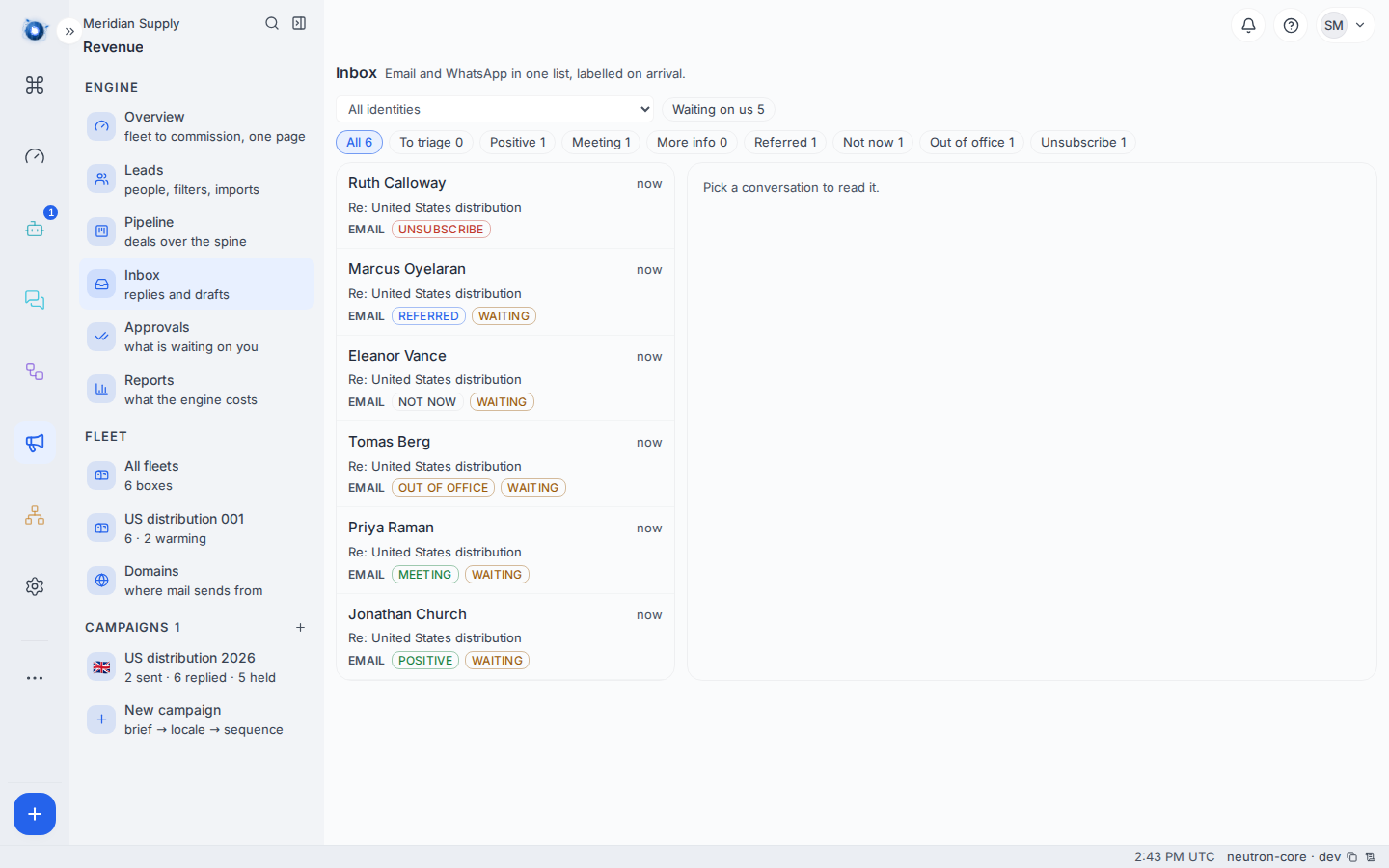
Across the top are eight filters with counts. The counts are of the whole inbox, not the filtered view — picking a filter narrows the list without moving the numbers, so you can always see how much is where.
Waiting on us counts conversations where they wrote last and nothing has answered.
2. Understand that the reply already acted
By the time you read a reply, the engine has read it and done what it means. This is the part people find surprising, and it is deliberate: somebody who asks to be left alone at 2am should not be written to again at 9am because nobody was awake.
| Label | What it did, on its own |
|---|---|
| Positive | Cancelled the queued follow-ups. Moved them along the pipeline. |
| Meeting | Cancelled the follow-ups. Moved them to the meeting column. |
| More info | Cancelled the follow-ups. Treated as engaged. |
| Referred | Cancelled the follow-ups. Created the person they named, at the same company, with a note saying who referred them. |
| Not now | Nothing cancelled. The next letter moved out ninety days. |
| Out of office | Nothing cancelled. The next letter moved past the day they said they are back. |
| Unsubscribe | Suppressed that address permanently, everywhere. Ended their run. Cancelled the rest. |
| To triage | Nothing. Nothing could read it, so it is waiting for you. |
Two of those are worth dwelling on.
Out of office is not a no. They are away, not uninterested, so nothing is cancelled — only the date moves, to the day their message named. A message saying “back on 14 September” moves the next letter past the fourteenth.
Unsubscribe is permanent and account-wide. It is not per campaign. It cannot be undone by importing them again.
3. Read one
Click a conversation.
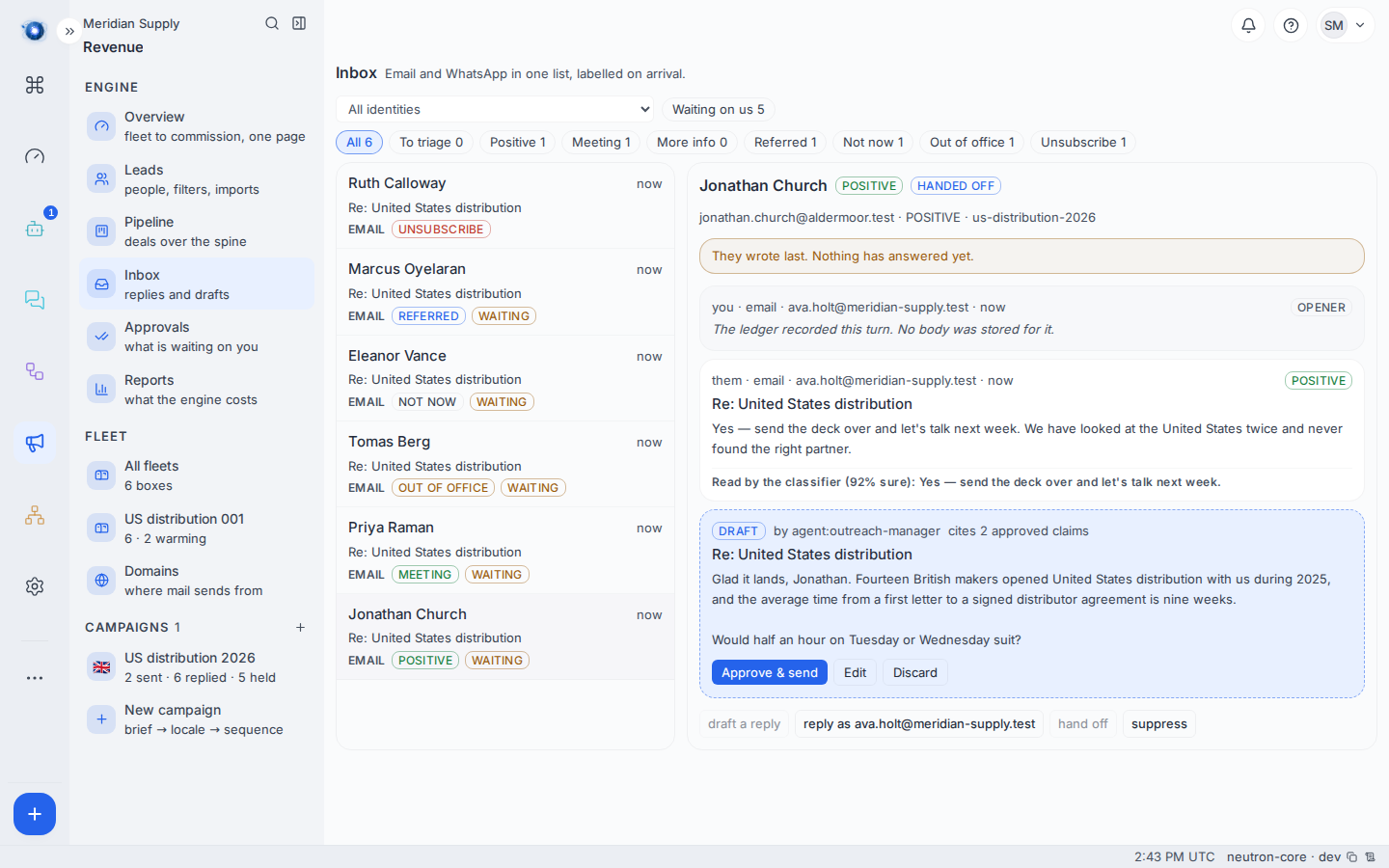
The reading pane shows the message and, underneath it, how it was read:
Read by the classifier (92% sure): Yes — send the deck over and let’s talk next week.
Three things are on that line. Who read it — the classifier, the deterministic pass, or a person. How sure it was. The sentence it read it from.
That last one matters most. You are not being asked to trust a label; you are being shown the words it came from, so you can disagree with an argument rather than a verdict.
A reading nothing could make says nothing at all, and the conversation sits in To triage.
4. Correct a wrong label
Click the label and pick the right one.
Two things happen. The label changes everywhere — the thread, the counts, the pipeline. And everything the new reading means is carried out: correcting to “not now” moves the follow-up out ninety days, correcting to “unsubscribe” suppresses the address.
Nothing is undone. A cancelled sequence stays cancelled and a suppression stays, because lifting a suppression on a second reading is how somebody who asked to be left alone gets written to again.
The pair — what the machine said, what you said — is kept. That is how the reading gets better.
5. Hand off
Hand off moves the conversation to a person and takes it out of the automatic flow. Use it the moment a reply needs a human answer rather than a drafted one.
A worked example
Meridian Supply open the Inbox and find six replies, each already labelled.
- Jonathan Church · Positive. “Yes — send the deck over.” His two remaining follow-ups were cancelled the moment it arrived.
- Priya Raman · Meeting. “Thursday at 14:00 works.” She is in the meeting column.
- Tomas Berg · Out of office. Back on the fourteenth. His next letter moved past it. Nothing cancelled.
- Eleanor Vance · Not now. “Not this quarter.” Her next letter is ninety days out.
- Marcus Oyelaran · Referred. He named Naomi Frost. She now exists at the same company, with a note saying Marcus referred her.
- Ruth Calloway · Unsubscribe. Read without a model — the words were plain. Suppressed, run ended.
One is wrong: Eleanor’s “not this quarter, ask me again after the spring buying season” is closer to interested than to no. They correct it to More info. Her follow-ups cancel and she moves along the pipeline.
What to do if
A reply is in To triage and looks obvious to you. The engine refuses to guess. Label it yourself; the correction teaches it.
A label is wrong and it already acted. Correct it. The new label’s effects run. What was cancelled stays cancelled — restart the person from the Leads screen if you want them written to again.
Somebody was suppressed by mistake. Suppression is deliberately hard to lift, and lifting it is not something the Inbox will do. Treat it as final; if it truly was an error, it needs someone with administrative access and a good reason.
A reply never appeared. The vendor’s webhook is probably not pointed at your instance. See journey 1, step 2, and then journey 12.
The thread shows no message body. Older records kept only the fact of a message. It says so rather than showing an empty letter.
Confirm it worked: the filter counts across the top of the Inbox match what you expect, and the corrected conversation carries its new label in both the list and the thread.