11 · How a company maps its work onto this
What you will have done: worked out where each layer of your company’s planning lives, from the year down to the week, and what to do about the one layer that has no home here yet.
The shape most companies already have
Almost every company plans on four timescales, whatever they call them. Three of them fit Projects directly.
    flowchart TD
  Y["A year<br/>where the company is going"] -->|"NOT IN NEUTRON YET"| Q
  Q["A quarter<br/>a plan per big decision"] -->|"signed off"| E["Phases become epics"]
  E --> I["Items"]
  I --> S["A week<br/>a sprint delivers some of them"]
  I --> M["Fixed dates<br/>milestones on the timeline"]
  S --> R["What actually happened<br/>the board, the history, the comments"]
Year: where the company is going
This does not live in Neutron. There is no place to write an objective, no place to put a number against it, and nothing that rolls work up to one.
Keep the year somewhere else for now: a page in your wiki, a document, a spreadsheet. Then link that page from the plans it produced, which is exactly what a plan’s links are for. The connection between the year and the work is a link a person maintains.
Quarter: one plan per decision
A quarter is a handful of decisions, not a list of tasks. Write one plan per decision. Move the warehouse to Unit 7 is a plan. Get better at fulfilment is not.
Each plan carries a summary of what changes and why now, links out to wherever the thinking lives, and a small number of phases. Getting it accepted is a conversation with a person, on the record. Signing it off turns the phases into epics on the board.
That is the join between deciding and doing, and it is the one place where a decision produces work automatically rather than somebody transcribing it.
Phases become epics
An epic is a phase of a plan: a chunk large enough that other work hangs under it, small enough to finish. Three to five per plan is normal. The Epics screen shows how much of each is done.
An epic asks for review before it closes, unless you turn that off. Closing an epic is a claim that a phase is finished, and that is worth a second person’s eyes.
Week: a sprint delivers some of it
A sprint is the week. Pull work from the epics into the week, run it, close it, and decide where the leftovers go. Closing a sprint is the moment somebody is forced to look at what did not happen, which is the only reason the ceremony is worth anything.
Fixed dates: milestones
Dates the business is committed to are milestones, not items. “Keys to Unit 7.” “Catalogue at the printer.” They sit in their own strip on the timeline above everything, so a busy quarter cannot push a deadline out of sight.
Where the record ends up
Everything that happened is on the cards: who moved what, who approved what, what was said and by whom. That is the point of having one tracker rather than a tracker and a chat log and somebody’s memory.
Reports turns some of that into numbers: what is still open through each day of the running sprint against the size it started at, how many items reached Done in each of the last twelve weeks, how long a card takes from picked up to finished, and how long a review waits before somebody decides it. It counts what the cards already say, so it is only as honest as the board is.
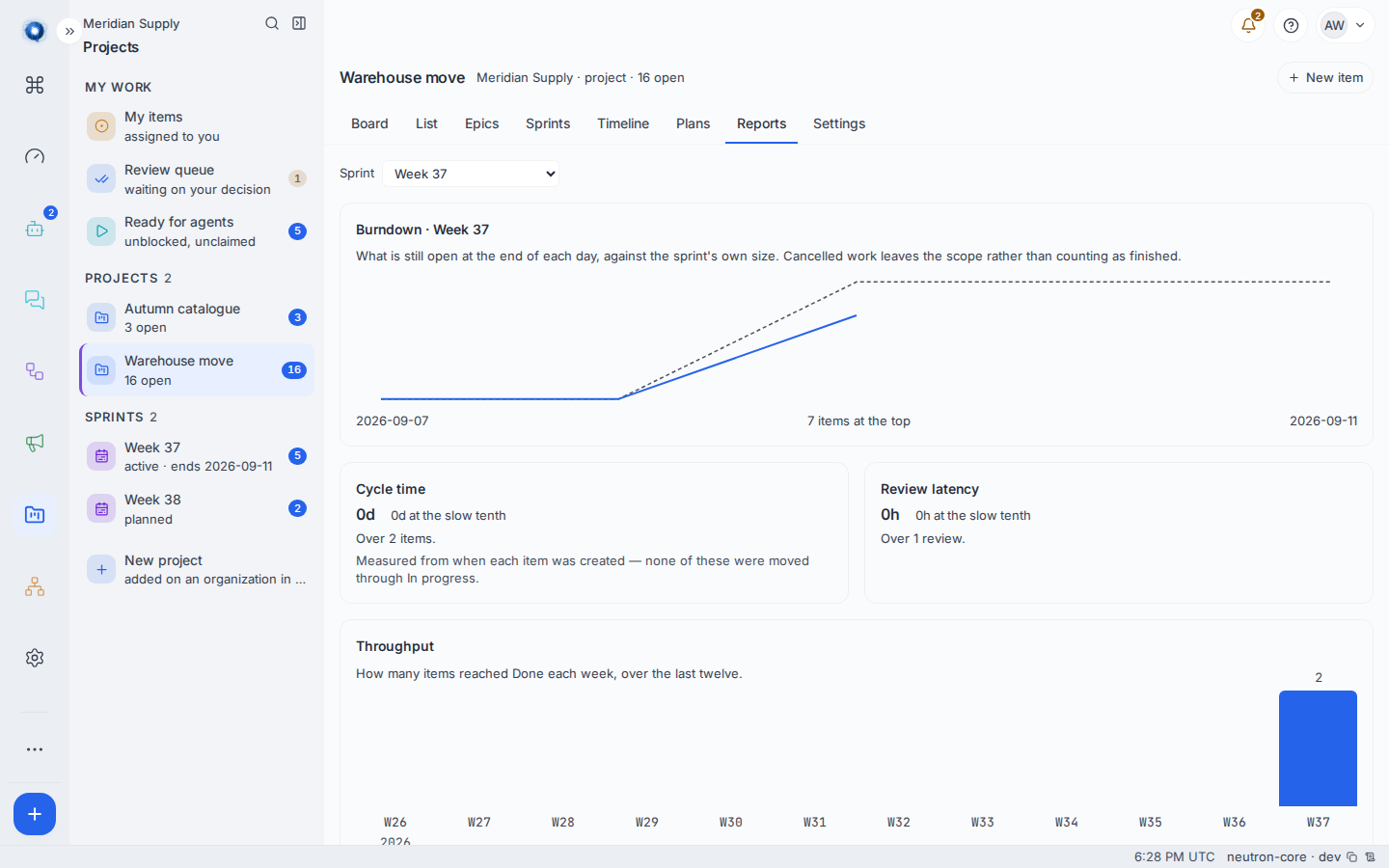
A worked example
Meridian Supply’s year, quarter and week.
| Layer | Where it lives | What it looks like |
|---|---|---|
| The year | A wiki page, outside Neutron | Double distribution capacity by January |
| The quarter | Two plans on the Warehouse move project | Move the warehouse to Unit 7 and Second picking line for the autumn peak, each linked back to the wiki page |
| The phases | Three epics, minted by signing the first plan off | Lease and paperwork · Racking and fit-out · Move week |
| The dates | Two milestones | Keys to Unit 7 · First pallet ships from Unit 7 |
| The weeks | Week 37, Week 38 | Five items in the running week |
| The record | The cards, and Reports | Who signed the lease, who approved the insurance, the note that said why, and how long each review waited |
The join from the year to everything under it is one link on each plan, kept by a person. That is the honest state of it today.
What can go wrong
| What you run into | What to do about it |
|---|---|
| You want a number against a goal and cannot find where to put one | There is nowhere. Keep the numbers where they are and link the page from the plan. |
| An epic has grown to forty items | It is a plan, not a phase. Split it. |
| Sprints keep carrying the same items forward | The carry-over question at close is the signal. If something has moved forward three times, cancel it or make it the week’s only job. |
| Milestones and due dates disagree | A milestone is the business’s date. A due date is a piece of work’s date. If the work is due after the milestone, the plan is wrong and the timeline is showing you that. |
| Somebody asks for a report of last quarter | Reports covers the running sprint, the last twelve weeks of throughput, cycle time and review latency. A quarter’s worth of narrative is still somebody reading the closed sprints and the plans. |
Confirm it worked: a person who has never seen your company can open one project and answer three questions from the screen: what are we doing, when is it due, and who is deciding it.