Projects
Projects is where a company keeps its work. A board with columns, a week’s worth of items, the epics they hang under, the dates they have to land on, and the record of who moved what. It is the same idea as any tracker you have used, with one difference that changes how it is run: a machine can be an assignee here, and a machine’s work goes through the same gate a person’s does.
- What it is for
- What is moving, who holds it, and when it has to land.
- Who uses it
- Everyone in the company, outside collaborators, and agents.
- Where in the UI
- The Projects rail: board, epics, sprints, timeline, plans.
- What it writes
- Items, epics, sprints, plans, and a status label on a linked issue.
- Which gate governs it
- The review gate, which the author may not open.
Full map: Map of Neutron Core
This section is written for somebody who has never opened it. You do not need to know what an epic is, what a sprint is for, or what any of the agents are called. Start with the first journey and work down.
Who this is for
A founder running one company. One project, one board, one week at a time. Everything below the first three journeys is optional.
A team lead with several projects. Projects sit under an organisation, each with its own board, its own weeks and its own members. Work in one can be linked to work in another without either team getting a copy.
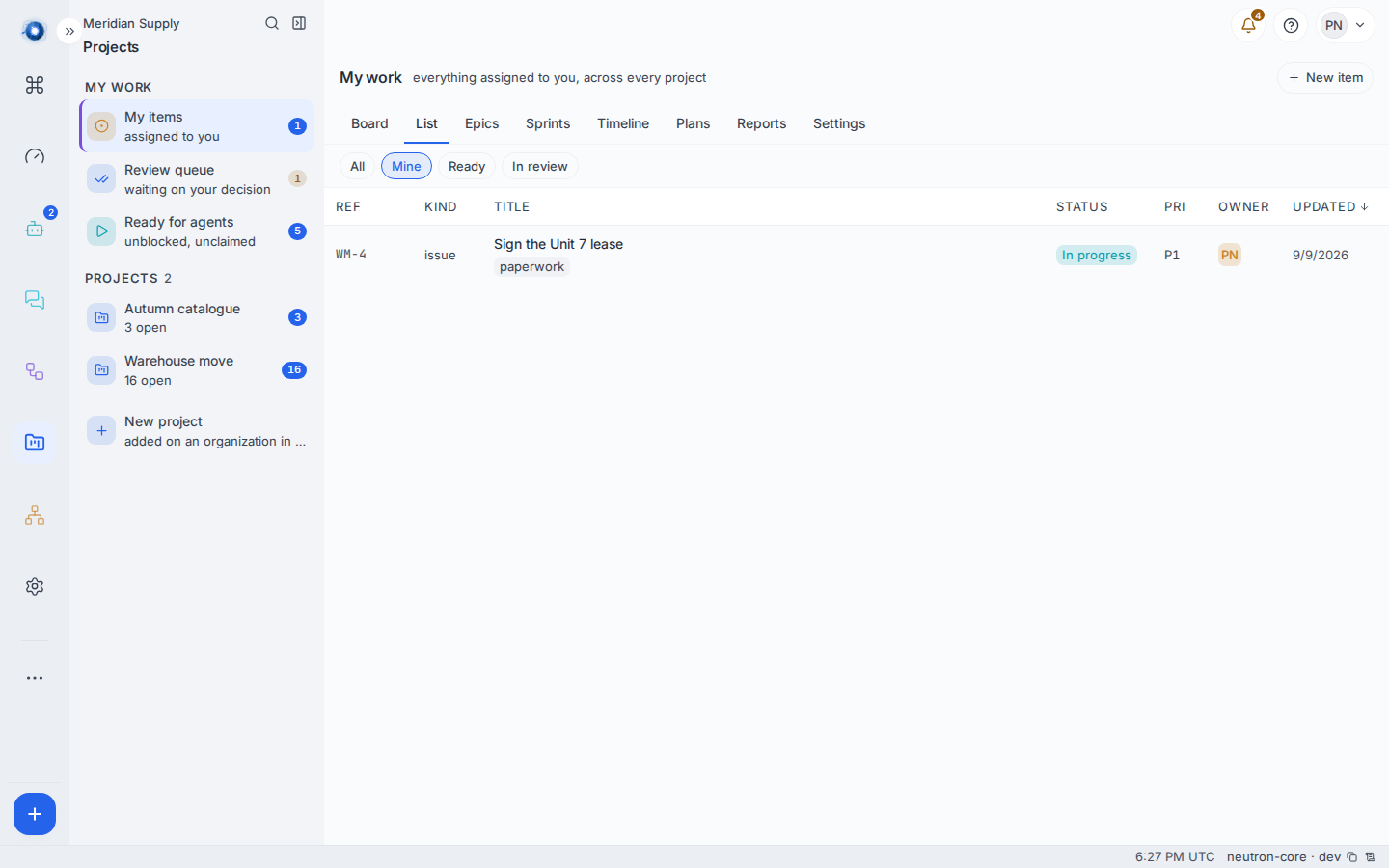
Somebody who only needs their own list. The rail’s first three rows are a person’s own work: what is assigned to them, what is waiting on their decision, and what is free to pick up. A contributor can live there and never open a board.
An outside collaborator. An advisor, an accountant, a contractor: put them on one project and they see that project. They can read it, comment on it, and be named as the person who reviews something. They see nothing else.
An agent. A Neutron agent reads the same board through its own tools. It can find unclaimed work, take it, do it and comment on it, and it is stopped at exactly the same gate a person is stopped at.
The whole shape, in one picture
    flowchart TD
  ORG["Organisation<br/>Meridian Supply"] --> P1["Project<br/>Warehouse move"]
  ORG --> P2["Project<br/>Autumn catalogue"]
  P1 --> PLAN["Plan<br/>what we decided to do"]
  PLAN -->|"signed off"| EPIC["Epic<br/>a phase of the plan"]
  EPIC --> ITEM["Item<br/>one piece of work"]
  P1 --> SPRINT["Sprint<br/>the week it is done in"]
  SPRINT --- ITEM
  P1 --> MILE["Milestone<br/>a date it must be done by"]
  MILE --- TL["Timeline<br/>bars, deadlines, what waits on what"]
  ITEM --- TL
  PERSON["A person"] -->|"moves, comments, decides"| ITEM
  AGENT["An agent"] -->|"claims, moves, comments"| ITEM
  ITEM -->|"asks for review"| GATE["Review gate<br/>somebody else decides"]
  GATE --> DONE["Done"]
Read it from the middle. An item is the unit of work. Everything above it groups items, everything below it moves them, and the gate is the one place a move can stop and wait for a person.
Four things worth knowing before anything else
Neutron is the tracker of record. If the work exists anywhere, it exists here. An item can name an issue on a code host, and the card’s status is written onto that issue as a label. Nothing comes back the other way, and there is no second copy to keep in step.
A card moves through one door. Dragging it, an agent calling a tool, a merged change naming it: all three end up in the same place, which checks the same rules and writes the same record. A rule that stops you stops the agent too.
Review is a gate somebody else opens. An item marked as needing review does not go to Done when it is finished. It goes to In review and waits. The person who asked cannot be the person who decides, an agent is never the person who decides, and everything an agent moves to Done waits whether it was marked or not.
A mention is heard once. Type @ in a comment, pick somebody, and a number appears on their bell. Opening the item clears it. Nobody has to remember to mark anything as read.
The board is drivable without a browser. Agents and MCP covers the tools an agent uses to file, claim, move and link work, and the review gate it cannot open.